Sebagai penutup dari rangkaian soal latihan bab per bab dengan materi astrofisika dasar, di-upload-kan daftar materi lengkap untuk materi astrofisika dasar (astrofisika 1). Filenya dapat didownload dari link yang ada di bawah ini. (Sumber : Dr. Djoni N. Dawanas)
Download link:
Daftar Materi Astrofisika 1
Untuk soal-soal dari bab-bab yang terkait astrofisika 1:
Sunday, September 7, 2008


Astrofisika : Bab 7 Bintang Ganda
Bab ini meliputi pembahasan tentang :
Selamat belajar. (sumber soal : Dr. Djoni N. Dawanas)
Download link:
Latihan Astrofisika Bab VII
(Untuk soal-soal dari bab-bab sebelumnya)
- Bintang Ganda Visual
- Penentuan Massa Komponen Bintang Ganda Visual
- Hubungan Massa Luminositas
- Bintang Ganda Astrometri
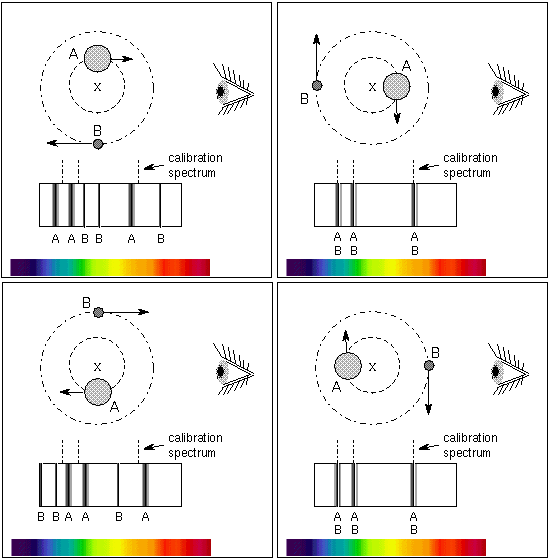
- Bintang Ganda Spektroskopi
- Penentuan Massa Komponen Bintang Ganda Spektroskopi
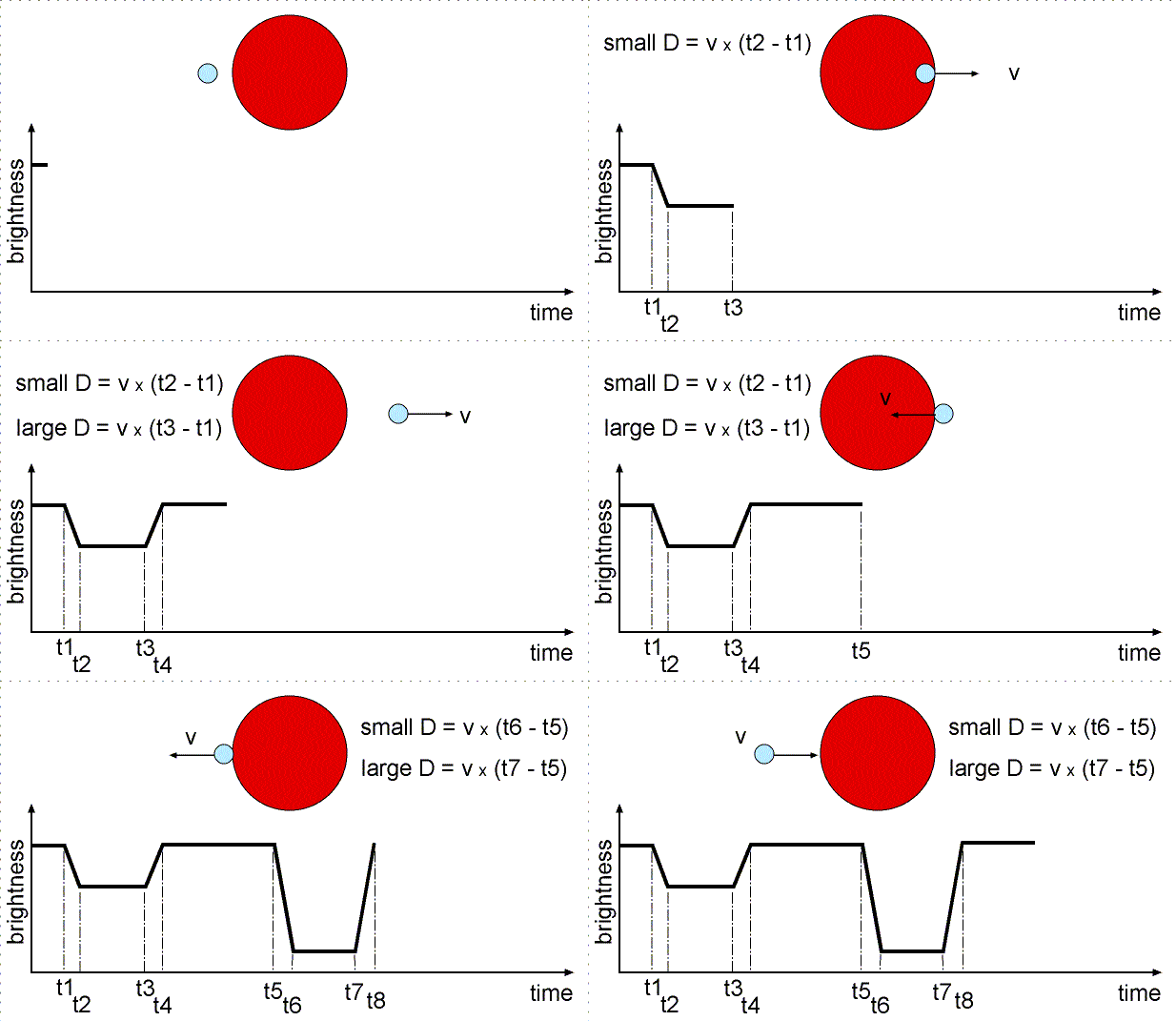
- Bintang Ganda Gerhana
- Penentuan Radius Komponen Bintang Ganda Spektroskopi
- Penentuan Massa Komponen Bintang Ganda Gerhana
- Animasi Kurva Kecepatan Radial
- Animasi bintang ganda spektroskopi bergaris ganda 1
- Animasi bintang ganda spektroskopi bergaris ganda 2
- Animasi Bintang Ganda Gerhana
- Animasi Kurva Cahaya Bintang Ganda Gerhana
Selamat belajar. (sumber soal : Dr. Djoni N. Dawanas)
Download link:
Latihan Astrofisika Bab VII
(Untuk soal-soal dari bab-bab sebelumnya)
Astrofisika : Bab 6 Gerak Bintang
Bab ini meliputi pembahasan tentang :
Soal latihan untuk bab ini dapat Anda download dari link di bawah.
Selamat belajar. (sumber soal : Dr. Djoni N. Dawanas)
Download link:
Latihan Astrofisika Bab VI
(Untuk soal-soal dari bab-bab sebelumnya)
- Gerak Sejati (Proper Motion)
- Gerak Matahari
- Paralaks Rata-Rata dan Paralaks Gugus
Soal latihan untuk bab ini dapat Anda download dari link di bawah.
Selamat belajar. (sumber soal : Dr. Djoni N. Dawanas)
Download link:
Latihan Astrofisika Bab VI
(Untuk soal-soal dari bab-bab sebelumnya)
Thursday, September 4, 2008
Trivia Quiz
Di bawah ini ada 2 buah gambar. Kedua gambar tersebut menunjukkan suatu fenomena astronomi tertentu. Coba tebak peristiwa apakah yang dimaksud? Dan kalau bisa, jelaskan juga apa penyebab timbulnya fenomena tersebut.
1.
2.
Jika Anda tahu, silakan isi comment dalam post ini. Jawaban akan di post minggu depan. Selamat mencoba.
1.

2.

Jika Anda tahu, silakan isi comment dalam post ini. Jawaban akan di post minggu depan. Selamat mencoba.
Wednesday, September 3, 2008
The Sky at Einstein’s Feet

The insights of relativity have illuminated a century of astronomical discovery, often going beyond the phenomena that Einstein lived to see. This book shows, in nonmathematical ways, how deeply these ways of viewing the Universe have informed our interpretations of it, and how many of the amazing discoveries of these decades have made sense only as part of Einstein’s universe.
The author brings together the ways in which we see the bizarre effects of relativity played out on a cosmic scale. None of this is particularly new to practicing astronomers, but much has yet to be seen outside technical journals. The presentation avoids mathematics (except for the most famous equation in all of physics!), and is designed to be accessible to the interested public. Gravitational lenses, the visible effects of light-travel delays, the search for black holes, the ways relativity in atomic nuclei makes stars shine, are all treated. In many cases, some of the principals are still alive and provided new commentary on the discoveries. Numerous illustrations are newly produced from data in the archives of such observatories as Hubble and Chandra.
Download link:
The Sky at Einstein’s Feet
Our Star : The Sun


 The Sun, as shown by the illustration to the left, can be divided into six layers. From the center out, the layers of the Sun are as follows: the solar interior composed of the core (which occupies the innermost quarter or so of the Sun's radius), the radiative zone, and the the convective zone, then there is the visible surface known as the photosphere, the chromosphere, and finally the outermost layer, the corona.
The energy produced through fusion in the Sun's core powers the Sun and produces all of the heat and light that we receive here on Earth. The process by which energy escapes from the Sun is very complex. Since we can't see inside the Sun, most of what astronomers know about this subject comes from combining theoretical models of the Sun's interior with observational facts such as the Sun's mass, surface temperature, and luminosity (total amount of energy output from the surface).
All of the energy that we detect as light and heat originates from nuclear reactions deep inside the Sun's high-temperature "core." This core extends about one quarter of the way from the center of Sun (where the temperature is around 15.7 million kelvin (K), or 28 million degrees Fahrenheit) to its surface, which is only 5778 K "cool".
 Above this core, we can think of the Sun's interior as being like two nested spherical shells that surround the core. In the innermost shell, right above the core, energy is carried outwards by radiation. This "radiative zone" extends about three quarters of the way to the surface. The radiation does not travel directly outwards - in this part of the Sun's interior, the plasma density is very high, and the radiation gets bounced around countless numbers of times, following a zig-zag path outward.
It takes several houndred thousand years for radiation to make its way from the core to the top of the radiative zone! In the outermost of the two shells, where the temperature drops below 2,000,000 K (3.5 million degrees F) the plasma in the Sun's interior is too cool and opaque to allow radiation to pass. Instead, huge convection currents form and large bubbles of hot plasma move up towards the surface (similar to a boiling pot of water that is heated at the bottom by a stove). Compared to the amount of time it takes to get through the radiative zone, energy is transported very quickly through the outer convective zone.
The Sun's visible surface the photosphere is "only" about 5,800 K (10,000 degrees F). Just above the photosphere is a thin layer called the chromosphere. The name chromosphere is derived from the word chromos, the Greek word for color. It can be detected in red hydrogen-alpha light meaning that it appears bright red. Above the surface is a region of hot plasma called the corona. The corona is about 2 million K (3.6 million degrees F), much hotter than the visible surface, and it is even hotter in a flare. Why the atmosphere gets so hot has been a mystery for decades; SOHO's observations are helping to solve this mystery.
 The Sun is not just a big bright ball. It has a complicated and changing magnetic field, which forms things like sunspots and active regions. The magnetic field sometimes changes explosively, spiting out clouds of plasma and energetic particles into space and sometimes even towards Earth. The solar magnetic field changes on an 11 year cycle. Every solar cycle, the number of sunspots, flares, and solar storms increases to a peak, which is known as the solar maximum. Then, after a few years of high activity, the Sun will ramp down to a few years of low activity, known as the solar minimum. This pattern is called the "sunspot cycle", the "solar cycle", or the "activity cycle".
Stars like the Sun shine for nine to ten billion years. The Sun is about 4.5 billion years old, judging by the age of moon rocks. Based on this information, current astrophysical theory predicts that the Sun will become a red giant in about five billion (5,000,000,000) years.
Source : SOHO Project
International Year of Astronomy 2009
 The International Astronomical Union (IAU) launched 2009 as the International Year of Astronomy (IYA2009) under the theme, The Universe, Yours to Discover. IYA2009 marks the 400th anniversary of the first astronomical observation through a telescope by Galileo Galilei. It will be a global celebration of astronomy and its contributions to society and culture, with a strong emphasis on education, public engagement and the involvement of young people, with events at national, regional and global levels throughout the whole of 2009. UNESCO has endorsed the IYA2009 and the United Nations proclaimed the year 2009 as the International Year of Astronomy on 20 December 2007.
 The vision of the International Year of Astronomy (IYA2009) is to help the citizens of the world rediscover their place in the Universe through the day- and night time sky, and thereby engage a personal sense of wonder and discovery. All humans should realize the impact of astronomy and basic sciences on our daily lives, and understand better how scientific knowledge can contribute to a more equitable and peaceful society.
Astronomy is one of the oldest fundamental sciences. It continues to make a profound impact on our culture and is a powerful expression of the human intellect. Huge progress has been made in the last few decades. One hundred years ago we barely knew of the existence of our own Milky Way. Today we know that many billions of galaxies make up our Universe and that it originated approximately 13.7 billion years ago. One hundred years ago we had no means of knowing whether there were other solar systems in the Universe. Today we know of more than 200 planets around other stars in our galaxy and we are moving towards an understanding of how life might have first appeared. One hundred years ago we studied the sky using only optical telescopes and photographic plates. Today we observe the Universe from Earth and from space, from radio waves to gamma rays, using cutting edge technology. Media and public interest in astronomy have never been higher and major discoveries are frontpage news throughout the world. The IYA2009 will meet public demand for both information and involvement.
There are outstanding opportunities for everyone to participate in the IAU IYA2009 events. This brochure outlines some of the events planned at the global level, which will be supported by thousands of additional national and regional activities.
The IAU, UNESCO and our Organisational Associates wish everyone a year rich in astronomical experiences as we all celebrate the International Year of Astronomy 2009!
For resources in the form of powerpoint and PDF, click on the following links.
- Powerpoint slides
- The International Year of Astronomy 2009
- The International Year of Astronomy 2009 - An overview
- What is astronomy?
- Who actually invented the astronomical telescope?
- PDF Version (Not the original version, this is more compressed versions)
This video below is the official trailer for the IYA 2009
Source : www.astronomy2009.org
Monday, September 1, 2008
Astrofisika : Bab 3 Besaran Mendasar dalam Astrofisika
Bab ini meliputi pembahasan tentang :
Soal latihan untuk bab ini dapat Anda download dari link di bawah.
Selamat belajar. (sumber soal : Dr. Djoni N. Dawanas)
Download link:
Latihan Astrofisika Bab III
- Besaran Matahari : Jarak, Massa, Luminositas, Radius, Temperatur Efektif Matahri
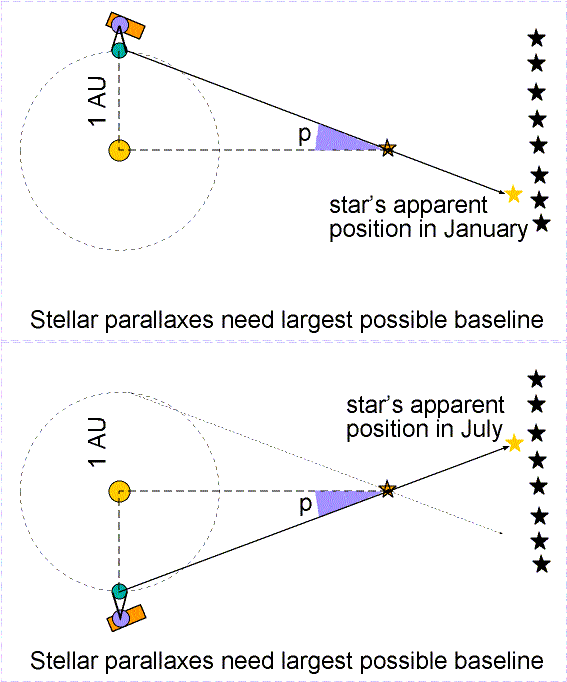
- Jarak bintang : metode paralaks
- Radius bintang : metode interferometri, okultasi Bulan, dan bintang ganda gerhana
Soal latihan untuk bab ini dapat Anda download dari link di bawah.
Selamat belajar. (sumber soal : Dr. Djoni N. Dawanas)
Download link:
Latihan Astrofisika Bab III
Subscribe to:
Posts (Atom)


 Posts
Posts