Showing posts with label news. Show all posts

Sunday, March 20, 2011

Supermoon 19 Maret 2011

Karena fenomena Supermoon ini cukup heboh dan banyak menimbulkan salah persepsi, mari coba dibahas sedikit meskipun sebenarnya fenomena ini bukanlah fenomena astronomi yang penting. Impact atau efeknya hampir tidak ada selain tinggi air pasang air laut sedikit lebih tinggi.

The Moon looks extra-big when it is beaming through foreground objects--a.k.a. "the Moon illusion." Credit: NASA

Dari perhitungan astronomi, pada tanggal 19 Maret 2011 Bulan dalam peredarannya mengelilingi Bumi, akan berada pada posisi paling dekat dengan Bumi, disebut sebagai posisi perigee. Tentunya dalam peredaran mengitari Bumi, Bulan akan selalui melalui posisi perigee, tetapi posisi perigee tersebut tidak selalu berada pada angka yang tepat sama, tetapi bervariasi sepanjang waktu.

Pada tanggal tersebut, yang pada saat itu Bulan dalam fase Purnama, dalam perhitungan merupakan jarak yang paling dekat ke Bumi semenjak 18 tahun yang lalu. Lalu? Apa yang akan terjadi? Beredar kabar di dunia maya, bahwa pada saat tersebut, akan terjadi bencana alam yang sangat dahsyat, mulai dari badai besar, gempa Bumi sampai dengan letusan gunung berapi. Sepertinya seram sekali! Tetapi benarkah itu?

Mari kita tinjau satu persatu, pertama, fenomena ‘supermoon’, ini sebetulnya adalah fenomena alam yang biasa terjadi. Pada suatu ketika, dalam peredarannya di langit, Bulan-Bumi-Matahari bisa berada dalam satu garis lurus, biasanya pada saat itu bisa terjadi bulan baru atau bulan purnama. Dan bila pada saat bulan purnama, Bulan berada pada posisi perigee, maka keadaan ini oleh para ahli astrologi (bukan ahli astronomi!) disebut ‘super moon’! Jadi istilah super moon bukanlah istilah astronomi, tetapi istilah astrologi.

Kedua, pada tanggal itu, akan terjadi bencana alam? Tentulah dalam siklus alamiah, Bulan mempengaruhi terjadinya gaya pasang surut laut di Bumi, dan ketika Bulan ‘mendekat’, tentulah pengaruh gravitasi Bulan menjadi lebih besar (demikian yang dikatakan hukum gravitasi Newton). Akan tetapi, apakah bila pengaruh gravitasi Bulan menjadi lebih besar, akan terjadi bencana alam? Mari kita sedikit berhitung dengan matematika. Ambil rata-rata jarak Bumi-Bulan 382900 km, sedangkan pada tanggal 19 Maret 2011, Bumi-Bulan berjarak 356577 km, atau ‘mendekat’ sejarak 26323 km, atau hanya 6,87% lebih dekat dibanding rata-rata.

Posisi Bulan saat berada di perigee atau titik terdekat dengan Bumi. courtsey physcorg.com

Dengan jarak yang sekecil itu (6,87%), akan menyebabkan dampak yang luar biasa? Seperti biasa, efek pasang surut terjadi setiap hari, dan bila resultan vektor gaya gravitasi Bulan & Matahari menjadi lebih besar maka efek pasang surut menjadi lebih besar. Menurut physorg.com (yang mengutip NASA), efek "perigeean ides" ini hanya menambah tinggi air pasang beberapa cm saja (maximum 15 cm).

Posisi Bumi-Bulan-Matahari dan kaitannya dengan pasang surut. kredit : Boomeria.org

Tentunya pada saat ketika purnama ditambah perigee, gaya gravitasi menjadi lebih berpengaruh, tetapi, dari studi geofisika yang telah banyak dilakukan, tidak dtemukan adanya dampak yang signifikan pada keseimbangan energi Bumi. Gempa Bumi, letusan vulkanik, ataupun berbagai fenomena di Bumi lebih disebabkan keseimbangan energi di Bumi, seperti pergeseran lempeng Bumi, sedangkan efek pasang surut oleh Bulan, tidaklah cukup kuat menggeser keseimbangan energi tersebut, yang artinya ‘super moon’ tidak akan menyebabkan bencana alam.

Mungkin dibutuhkan seorang Superman yang datang dari planet Kripton untuk menggeser keseimbangan Bumi, karena Superman mempunyai kekuatan yang jauh lebih besar dibanding kekuatan super moon; tetapi kita tahu bahwa superman adalah tokoh rekaan, sebagaimana bencana akibat super moon adalah telaah astrologi. Kalau sudah demikian, pertanyaan berikut, apa yang akan terjadi di tanggal 19 Maret yang akan datang?

Yang pasti Bulan akan tampak lebih ‘besar’ 14% dan 30% lebih cerlang di Banding ‘biasanya’, namun bisakah Anda membedakannya (bukan karena Anda punya asumsi awal bahwa Bulan lebih besar dari biasanya)?

Bulan Purnama saat di perigee akan tampak lebih besar 14%. kredit: NASA

Jawabannya belum tentu. Di langit tidak ada penggaris/meteran yang dapat digunakan untuk mengukur diameter Bulan (selain Anda menggunakan teleskop dengan skala ukuran di lensa nya). Jika Anda mengamati Bulan saat di titik tertingginya dan tidak ada benda lain sebagai pembanding, maka Anda tidak dapat membedakan bulan purnama ini (super moon) dengan bulan purnama biasa.

Untuk mendapatkan efek "piringan Bulan yang besar", Anda disarankan mengamati Bulan saat ada di dekat horizon. Pada posisi ini, ada efek ilusi optik yang akan menciptakan kesan bahwa piringan Bulan nampak lebih besar dari biasanya (efek ini terjadi pada saat gerhana Bulan "biasa" juga). Alasannya masih sulit dijelaskan oleh astronomer maupun psikolog. Bulan yang dekat dengan horizon akan nampak "sangat" besar (lihat ilustrasi gambar pertama).

So, apakah fenomena supermoon penting untuk diamati? jawabnya tergantung Anda. Anda bisa memanfaatkan momentum ini untuk mengadakan observasi Bulan bersama teman Anda, baik dengan mengamati langsung maupun dengan binokular/teleskop kecil.


Artikel di atas disadur dari Langit Selatan dengan beberapa perubahan yang diambil dari physorg.com.

Wednesday, February 9, 2011

Pseudoscience vs Science

Akhir - akhir ini banyak sekali berita di media massa yang nampak seperti science namun sebenarnya hanya pseudo-science. Berikut ini ada artikel yang bagus mengenai hal ini, yang dikutip dari www.astronomynotes.com. Selamat membaca dan semoga bermanfaat.


"Yes, the world would be a more interesting place if there were UFOs lurking in the deep waters off Bermuda and eating ships and planes, or if dead people could take control of our hands and write us messages. It would be fascinating if adolescents were able to make telephone handsets rocket off their cradles just be thinking at them, or if our dreams could, more often than can be explained by chance and our knowledge of the world, accurately foretell the future." Just one nice passage among many, many in Carl Sagan's "The Demon-Haunted World" (available in the campus library and most public libraries). Well, Dr. Sagan, if the world would be more interesting if the unexplained UFOs were in fact space aliens, if we could communicate with the dead or space aliens, etc., why are you scientists such stuffy, party-poopers, insisting that the evidence is not good enough to prove that these things exist? With thousands of eye-witnesses, what more do you need? Sagan wrote that passage above just before he discussed pseudoscience in "The Demon-Haunted World". If we understand the difference between real science and pseudoscience, perhaps we can understand the view of many scientists and skeptics that the UFO research is pseudoscience.

"Pseudo" means "not genuine; sham", something pretending to be something else that it is not. Pseudosciences "purport to use the methods and findings of science, while in fact they are faithless to its nature—often because they are based on insufficient evidence or because they ignore clues that point the other way" (Sagan, 1996). We are awash in pseudoscience from all around us because "pseudoscience is easier to contrive than science" ("contrive" is a pretty strong word choice by Dr. Sagan). With pseudoscience, the standards of argument and what is allowable as evidence are much more relaxed than what you find in science.

This is not to say that all of science is correct. No, there have been plenty of mistakes in science, plenty of blind alleys. No, reality is messier, more unpredictable than the best detective/murder-mystery novel. With science, hypotheses are framed in a way that they can be tested by experiment and observation. Nature has the final veto power in whatever explanation we come up with but scientists are human (yes, they are) and subject to emotional attachments to their explanations. They too can be offended when their pet explanation doesn't pan out, when Nature has vetoed it.

Pseudoscience is just the opposite. Hypotheses are often framed in a way that makes them untestable. "Practitioners [of pseudoscience] are defensive and wary. Skeptical scrutiny is opposed. When the pseudoscientific hypothesis fails to catch fire with scientists, conspiracies to suppress it are deduced" (Sagan, 1996). Ah, yes! How many times have we heard that the science journals won't publish the UFO research with charges of bias and close-mindedness on the part of the science "establishment"? Such charges are part of the conspiracy mindset. I'm sorry, but it is not a conspiracy. It is because the UFO evidence is not of the caliber needed to base conclusions upon and less fantastic alternative explanations that don't involve space aliens are not addressed or explored by the author of the proposed paper. Not every truly scientific paper makes it into the journals either but the scientist doesn't complain of a conspiracy. No, the paper was probably rejected because more data needed to be gathered to improve the signal (the confidence level) above the ever-present statistical fluctuations of reality in order to deduce the conclusion reached by the author. Sometimes, too strong a conclusion is deduced from too weak a data set. Another likelihood is that the author did not explore an alternative explanation because they failed to see the assumptions that they were operating under. Our filters can blind us to the obvious.

"Perhaps the sharpest distinction between science and pseudoscience is that science has a far keener appreciation of human imperfections and fallibility than does pseudoscience." (Sagan, 1996) This is why conclusions based solely (or even mostly) on eye-witness testimony are not acceptable in science, however harsh that may seem to the layman. The Innocence Project (see www.innocenceproject.org) has shown that eyewitness identification has played a significant role in 75% of the convictions that were later overturned through DNA testing. Thirty years of social science research has proven that eyewitness identification is often unreliable. Even victims of horrendous personal crimes have mis-identified the perpetrators. Unfortunately, our memories are malleable. Initial uncertainties in recollection become strongly-held beliefs, bed-rock certainties, once we've had time to try to make sense of what happened. Our creativity can sometimes lead us astray. It can happen to the best of us. Even scientists. Please see Christopher Chabris' and Daniel Simons' Invisible Gorilla website for some of this research and especially see Dan Simons' "Counter-Intuition" talk he gave in April 2010. There is a video of his short talk in the video section of Invisible Gorilla in which he gives powerful examples of our perceptions, intuitions, and even the reasoning about our intuition leading even the best of observers astray. That is why scientists lay their results open to the very critical scrutiny of others. And they agree to accept the criticism and re-submit their work when they have improved their argument through better data or give it up when the observations show that their idea does not have merit. They don't blame the "establishment".

So, it is not because scientists just don't want to believe in space aliens that they are critical of the claims of UFOs as aliens, it is because time and time again the methodology of the UFO claims have not followed the high standards of verifiable scientific research. Has every claim of UFOs-as-space aliens been investigated? No. There are so many! It takes more time and energy to figure out the ordinary, natural cause of something than it takes for creative people to imagine fantastic things. Perhaps scientists are a bit too quick to discount UFOs-as-space aliens claims but after years of going down that dead end interpretation of noisy data, can you understand why they might want to devote their time to something more provable?

The next several pages are lengthy excerpts of Sagan's "The Demon-Haunted World: Science as a Candle in the Dark", published by Ballantine Books (New York) in 1996 (ISBN 0-345-40946-9). These excerpts are examples of alternative, plausible explanations that "point the other way" from that of space aliens and government cover-ups of space alien invasions.

Roswell, New Mexico

What follows is an excerpt from Sagan's "The Demon-Haunted World" about the alleged flying saucer crash in Roswell, NM in 1947 (page 84-86).


A great to-do has been made of one or more alleged crashed flying saucers near Roswell, New Mexico, in 1947. Some initial reports and newspaper photographs of the incident are entirely consistent with the idea that the debris was a crashed high-altitude balloon. But other residents of the region—especially decades later—remember more exotic materials, enigmatic hieroglyphics, threats by military personnel to witnesses if they didn't keep what they knew to themselves, and the canonical story that alien machinery and body parts were packed into an airplane and flown to the Air Materiel Command at Wright-Patterson Air force Base. Some, but not all, of the recovered alien body stories are associated with this incident.


Philip Class, a long-time and dedicated UFO skeptic, has uncovered a subsequently declassified letter dated July 27, 1948, a year after the Roswell" incident," from Major General C.B. Cabell—then Director of Intelligence for the U.S. Air Force (and later, as a CIA offical, a major figure in the abortive U.S. invasion of Cuba at the Bay of Pigs). Cabell was inquiring of those who reported to him on what UFOs might be. He hadn't a clue. In an October 11, 1948 summary response, explicitly including information in the possession of the Air Materiel Command, we find the Director of Intelligence being told that nobody else in the Air Force had a clue either. This makes it unlikely that UFO fragments and occupants had made their way to Wright-Patterson the year before.


What the Air Force was mostly worried about was that UFOs were Russian. Why Russians would be testing flying saucers over the United States was a puzzle to which the following four answers were proposed: "(1) To negate U.S. confidence in the atom bomb as the most advanced and decisive weapon in warfare. (2) To perform photographic reconnaissance missions. (3) To test U.S. air defenses. (4) To conduct familiarization flights [for strategic bombers] over U.S. territory." We now know that UFOs neither were or are Russian, and however dedicated the Soviet interest may have been to objectives (1) through (4), flying saucers weren't how they pursued these objectives.


Much of the evidence regarding the Roswell "incident" seems to point to a cluster of high-altitude classified balloons, perhaps launched from nearby Alamogordo Army Air Field or White Sands Proving Ground, that crashed near Roswell, the debris of secret instruments hurriedly collected by earnest military personnel, early press reports announcing that it was a spaceship from another planet ("RAAF Captures Flying Saucer on Ranch in Roswell Region"), diverse recollections simmering over the years, and memories refreshed by the opportunity for a little fame and fortune. (Two UFO museums in Roswell are leading tourist stops.)
A 1994 report ordered by the Secretary of the Air Force and the Department of Defense in response to prodding from a New Mexico Congressman identifies the Roswell debris as remnants of a long-range, highly secret, balloon-borne low-frequency acoustic detection system call "Project Mogul"—an attempt to sense Soviet nuclear weapons explosions at tropopause altitudes. The Air Force investigators, rummaging comprehensively through the secret files of 1947, found no evidence of heightened message traffic:


There were no indications and warnings, notice of alerts, or a higher tempo of operational activity reported that would be logically generated if an alien craft, whose intentions were unknown, entered U.S. territory…The records indicated that none of this happened (or if it did, it was controlled by a security system so efficient and tight that no one, U.S. or otherwise, has been able to duplicate it since. If such a system had been in effect at the time, it would have also been used to protect our atomic secrets from the Soviets, which history has shown obviously was not the case.)


The radar targets carried by the balloons were partly manufactured by novelty and toy companies in New York, whose inventory of decorative icons seems to have been remembered many years later as alien hieroglyphics.


In an earlier passage Sagan notes that balloons were extensively used by the Air Force in the 1950s for various uses including robotic espionage craft, with high-resolution cameras and signal intelligence devices. "High-altitude balloons can seem saucer-shaped when seen from the ground. If you misestimate how far away they are, you can easily imagine them going absurdly fast. Occasionally, propelled by a gust of wind, they make abrupt changes in direction, uncharacteristic of aircraft and in seeming defiance of the conservation of momentum—if you don't realize that they're hollow and weigh almost nothing." (p. 83) Please remember this when you read about reports of alien craft capable of accelerations and sudden changes of trajectory that are impossible with modern aircraft and would create fatal g-forces for humans.

Spoofing

Another excerpt from Sagan's "The Demon-Haunted World" that gives a plausible explanation of the unknown radar events during the Cold War that were kept under wraps (p. 86-87):


Consider spoofing. In the strategic confrontation between the United states and the Soviet Union, the adequacy of air defenses was a vital issue. It was item (3) on General Cabell's list. If you could find a weakness, it might be the key to "victory" in an all-out nuclear war. The only sure way to test your adversary's defenses is to fly an aircraft over their borders and see how long it takes for them to notice. The United States did this routinely to test Soviet air defenses.


In the 1950s and ‘60s, the United States had state-of-the-art radar defense systems covering its west and east coats, and especially its northern approaches (over which a Soviet bomber or missile attack would most likely come). But there was a soft underbelly—no significant early warning system to detect the geographically much more taxing southern approach. This is of course information vital for a potential adversary. It immediately suggests a spoof: One or more of the adversary's high-performance aircraft zoom out of the Caribbean, let's say, into U.S. airspace, penetrating, let's say, a few hundred miles up the Mississippi River until a U.S. air defense radar locks on. Then the intruders hightail it out of there. (Or, as a control experiment, a unit of U.S. high-performance aircraft is sequestered and sent in unannounced sorties to determine how porous American air defenses are.) In such a case, there may be combined visual and radar sightings by military and civilian observers and large numbers of independent reports. What is reported corresponds to no known aircraft. The Air Force and civilian aviation authorities truthfully state that none their aircraft was responsible. Even if they've been urging Congress to fund a southern Early Warning System, the Air Force is unlikely to admit that Soviet or Cuban aircraft got to New Orleans, much less Memphis, before anybody caught on.


Here again, we have every reason to expect a high-level technical investigating team, Air Force and civilian observers told to keep their mouths shut, and not just the appearance but the reality of suppression of data. Again, this conspiracy of silence need have nothing to do with alien spacecraft. Even decades later, there are bureaucratic reasons for the Department of Defense to be close-mouthed about such embarrassments. There is a potential conflict of interest between parochial concerns of the Department of Defense and the solution of the UFO enigma.

Government Conspiracies

One last excerpt from Sagan's "The Demon-Haunted World" about oft-lodged charge of the government's conspiracy of silence (p. 92-93). (Any more excerpts and I'll surely be charged with copyright infringement—please read the book for more! Though much lengthier excerpts are available for free on the Google Books version...)

A cover-up to keep knowledge of extraterrestrial life or alien abductions almost wholly secret for 45 years, with hundreds if not thousands of government employees privy to it, is a remarkable notion. Certainly, government secrets are routinely kept, even secrets of substantial general interest. But the ostensible point of such secrecy is to protect the country and its citizens. Here, though, it's different. The alleged conspiracy of those with security clearances is to keep from the citizens knowledge of a continuing alien assault on the human species. If extraterrestrials really were abducting millions of us, it would be much more than a matter of national security. It would impact the security of all human beings everywhere on Earth. Given such stakes, is it plausible that no one with real knowledge and evidence, in nearly 200 nations, would blow the whistle, speak out and side with the humans rather than the aliens?

Since the end of the Cold War NASA has been flailing about, trying to find missions that justify its existence—particularly a good reason for humans in space. If the Earth were being visited daily by hostile aliens, wouldn't NASA leap on this opportunity to augment is funding? And if an alien invasion were in progress, why would the Air Force, traditionally led by pilots, step back from manned spaceflight and launch all its payloads on unmanned boosters?

Consider the former Strategic Defense Initiative Organization, in charge of "Star Wars." It's fallen on hard times now [in 1996], particularly its objective of basing defenses in space. Its name and perspective have been demoted. It's the Ballistic Missile Defense Organization these days. It no longer even reports directly the Secretary of Defense. The inability of such technology to protect the United States against a massive attack by nuclear-armed missiles is manifest. But wouldn't we want at least to attempt deployment of defenses in space if we were facing an alien invasion?

The Department of Defense, like similar ministries in every nation, thrives on enemies, real or imagined. It is implausible in the extreme that the existence of such an adversary would be suppressed by the very organization that would most benefit from its presence. The entire post-Cold War posture of the military and civilian space programs of the United States (and other nations) speaks powerfully against the idea that there are aliens among us—unless, of course, the news is also being kept from those who plan the national defense. [No, please don't take the bait dangling in that last sentence…]

Tuesday, February 8, 2011

A Brief History of Observing the Sun

A little history of sun-watching and science from our friends at the Solar Dynamics Observatory.

Source: Universe Today

Monday, February 7, 2011

Definisi Planet - Mengapa Pluto tidak termasuk kategori Planet?

Mungkin beberapa tahun lalu, jumlah planet yang kita kenal ada 9, yaitu: Merkurius, Venus, Bumi, Mars, Jupiter, Saturnus, Uranus, Neptunus dan Pluto. Namun, tahukah Anda bahwa pada tahun 2006, International Astronomical Union (IAU) telah menentukan definisi planet yang baru. Imbas dari definisi planet yang baru ini sangat besar, karena Pluto yang sudah familiar dikenal sebagai sebuah planet akhirnya harus tersingkir dari "gelar"-nya. Tahukah Anda mengapa Pluto akhirnya "tersingkir"?

Planet, secara etimologis berarti pelancong (wanderer). Pada akhir abad ke-19, istilah Planet sudah menjadi istilah umum, meskipun belum ada batasan yang jelas mengenai kriteria suatu benda yang dapat dianggap sebagai planet. Umumnya, istilah "planet" diberikan kepada objek yang mengitari Matahari dan berukuran lebih besar daripada Pluto.

Setelah tahun 1992, astronomer telah menemukan banyak objek di luar orbit Neptunus (dikenal dengan istilah Trans-Neptunian Objects atau TNO) dan ratusan objek yang mengitari bintang lain (extrasolar planet, lihat artikel sebelumnya). Penemuan ini tidak hanya menambah jumlah dr objek yang potensial disebut planet, tetapi juga memperluas kenaekaragaman dan keanehan (peculiarity) dari objek-objek yang "masuk" kategori planet berdasarkan definisi/pengertian umum. Beberapa objek yang ditemukan tersebut ada yang lebih kecil daripada satelit Bumi, Bulan dan ada juga yang cukup besar untuk menjadi sebuah bintang. Penemuan - penemuan inilah yang membuat astronom merasa adanya kebutuhan untuk menentukan definisi dari sebuah Planet secara jelas agar tidak sembarang objek bisa dianggap sebagai planet.

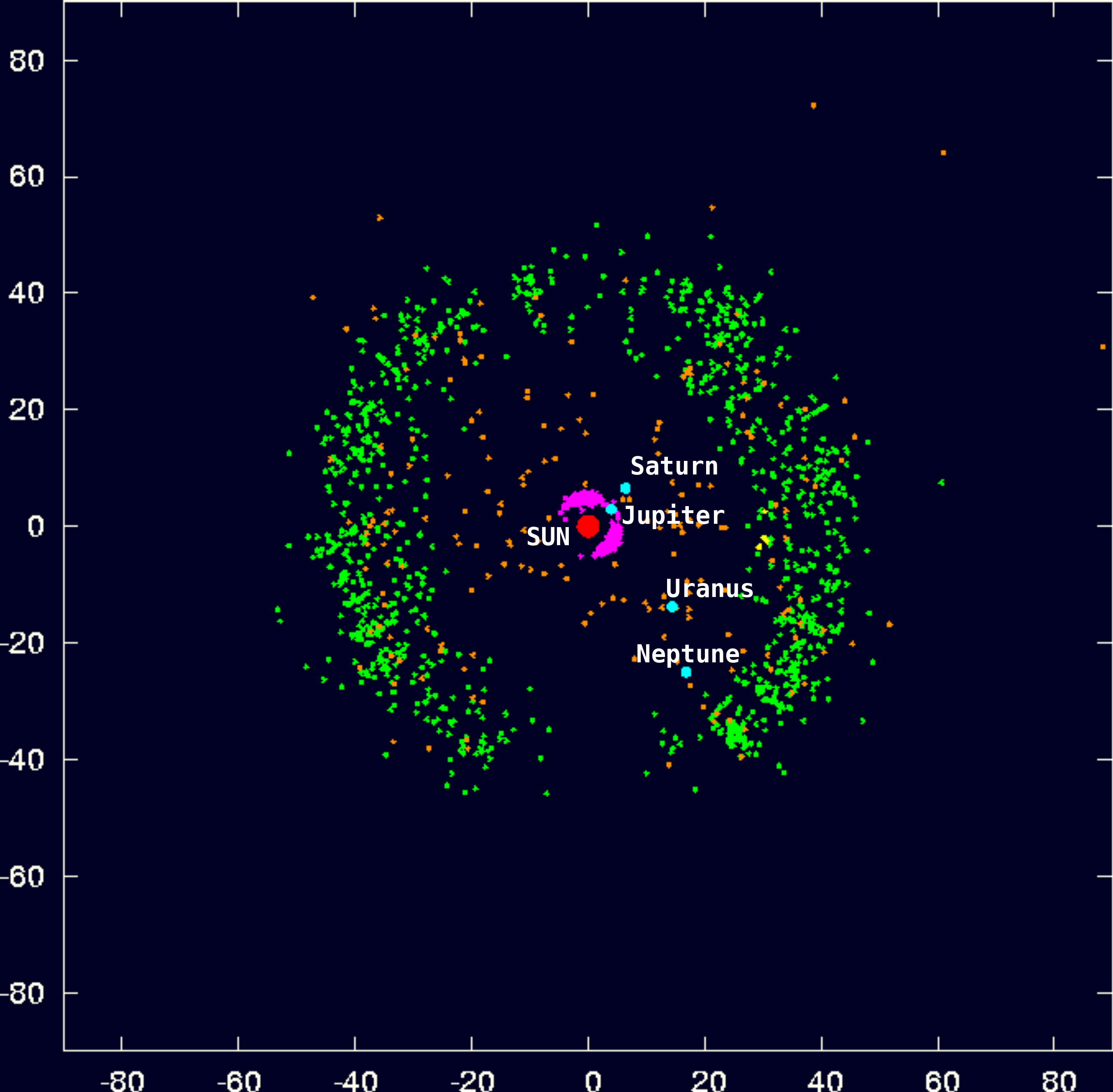
File:Outersolarsystem objectpositions labels comp.png
Plot of the positions of all known Kuiper belt objects (green), set against the outer planets (blue)

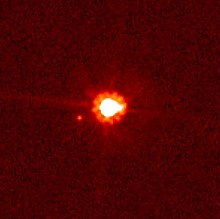
Perlunya definisi yang jelas untuk Planet menjadi semakin jelas ketika ditemukannya TNO yang diberi nama Eris. Ukuran Eris lebih besar daripada ukuran Pluto, yang sebelumnya dianggap sebagai ukuran minimum untuk sebuah planet. Oleh sebab itu, pada bulan Agustus 2006, International Astronomical Union (IAU) mengadakan konferensi untuk membuat definisi baru Planet.
Eris as seen with the Hubble Space Telescope

DEFINISI PLANET BERDASARKAN IAU TAHUN 2006

The final definition, as passed on 24 August 2006 under the Resolution 5A of the 26th General Assembly is:


Illustration of the outcome of the vote

The IAU resolves that planets and other bodies, except satellites, in our Solar System be defined into three distinct categories in the following way:

(1) A planet [1] is a celestial body that:
  • (a) is in orbit around the Sun,
  • (b) has sufficient mass for its self-gravity to overcome rigid body forces so that it assumes a hydrostatic equilibrium (nearly round) shape, and
  • (c) has cleared the neighbourhood around its orbit.
(2) A "dwarf planet" is a celestial body that (a) is in orbit around the Sun, (b) has sufficient mass for its self-gravity to overcome rigid body forces so that it assumes a hydrostatic equilibrium (nearly round) shape [2], (c) has not cleared the neighbourhood around its orbit, and (d) is not a satellite.

(3) All other objects [3], except satellites, orbiting the Sun shall be referred to collectively as "Small Solar System Bodies".

Footnotes:
[1] The eight planets are: Mercury, Venus, Earth, Mars, Jupiter, Saturn, Uranus, and Neptune.
[2] An IAU process will be established to assign borderline objects into either dwarf planet and other categories.
[3] These currently include most of the Solar System asteroids, most Trans-Neptunian Objects (TNOs), comets, and other small bodies.

The IAU further resolves:
Pluto is a "dwarf planet" by the above definition and is recognized as the prototype of a new category of Trans-Neptunian Objects[1].

Footnote:
[1] An IAU process will be established to select a name for this category.
The IAU also resolved that "planets and dwarf planets are two distinct classes of objects", meaning that dwarf planets, despite their name, would not be considered planets
.
Penjelasan di atas adalah bunyi dari keputusan IAU mengenai definisi Planet yang baru. Secara sederhana, syarat- syarat sebuah objek dapat dikategorikan sebagai planet dalam tata surya ini jika:
  1. mengitari Matahari
  2. memiliki massa yang cukup untuk mencapai kondisi kesetimbangan hidrostatis (secara sederhana, objek yang sudah mencapai kondisi kesetimbangan hidrostatis memiliki bentuk bola sempurna).
  3. telah "membersihkan objek-objek tetangga" dari orbitnya. atau dengan kata lain, massa Planet adalah massa yang dominan dibandingkan massa seluruh benda lain yang berada di orbit yang sama.
Sebuah objek yang tidak termasuk satelit dan hanya memenuhi dua syarat pertama akan diklasifikasikan sebagai dwarf planet (planet kerdil). Bagi objek yang hanya memenuhi syarat pertama (mengitari Matahari), akan disebut Small Solar System Body (SSSB) atau objek kecil di tata surya. Draft awal merencanakan akan memasukkan dwarf planet sebagai sub-kategori dari planet, tetapi karena keputusan ini akan mengakibatkan penambahan beberapa lusin objek ke dalam tata surya, draft ini dibatalkan. Di tahun 2006, yang termasuk dwarf planet adalah Ceres, Eris, Makemake, dan Pluto. Keputusan ini termasuk keputusan yang kontroversial dan menimbulkan dukungan dan kritik dari cukup banyak astronom, tetapi definisi inilah yang dipakai resmi hingga saat ini.

Jad, berdasarkan definisi yang baru ini, saat ini ada 8 planet yang diakui (Merkurius, Venus, Bumi, Mars, Jupiter, Saturnus, Uranus, dan Neptunus) dan ada lima planet kerdil (Pluto, Ceres, Eris, Makemake, dan Haumea). Definisi ini hanya berlaku untuk Tata Surya kita karena extrasolar Planet belum diketahui dengan jelas/akurat ukurannya. Extrasolar planets atau exoplanets akan didefinisikan dalam referensi lain, yang memisahkan/membedakan exoplanet dan dwarf stars (bintang kerdil).

Pertanyaan evaluasi:
1. Mengapa perlu adanya definisi baru untuk Planet?
2. Jelaskan definisi baru/syarat-syarat sebuah objek dijadikan Planet? Planet Kerdil?

Thursday, January 27, 2011

Hubble Discovers Most Distant Galaxy Yet!

Hubble Ultra Deep Field - Part D

No Princess is sending holographic help messages. No Hans Solo is warming up a Millenium Falcon to jump into hyperdrive. We don’t even have a Death Star waiting around the corner. But, what we do have is evidence that astronomers have pushed the Hubble Space Telescope to its limits and have seen further back in time than ever before. “We are looking back through 96% of the life of the universe, and in so doing, we have found just one galaxy, but it is one, but it is a remarkable object. The universe was only 500 million years old at that time versus it now being thirteen thousand-seven hundred million years old. ” said Garth Illingworth, Ames Research Scientist. We know about the Hubble Ultra Deep Field, but we invite you to boldy go on…

While studying ultra-deep imaging data from the Hubble Space Telescope, an international group of astronomers have found what may be the most distant galaxy ever seen, about 13.2 billion light-years away. “Two years ago, a powerful new camera was put on Hubble, a camera which works in the infrared which we had never really good capability before, and we have now taken the deepest image of the universe ever using this camera in the infrared.” said Garth Illingworth, professor of astronomy and astrophysics at the University of California, Santa Cruz. “We’re getting back very close to the first galaxies, which we think formed around 200 to 300 million years after the Big Bang.” The study pushed the limits of Hubble’s capabilities, extending its reach back to about 480 million years after the Big Bang, when the universe was just 4 percent of its current age. The dim object, called UDFj-39546284, is a compact galaxy of blue stars that existed 480 million years after the Big Bang, only four percent of the universe’s current age. It is tiny. Over one hundred such mini-galaxies would be needed to make up our Milky Way.

The farthest and one of the very earliest galaxies ever seen in the universe appears as a faint red blob in this ultra-deep–field exposure taken with NASA's Hubble Space Telescope. This is the deepest infrared image taken of the universe. Based on the object's color, astronomers believe it is 13.2 billion light-years away. (Credit: NASA, ESA, G. Illingworth (University of California, Santa Cruz), R. Bouwens (University of California, Santa Cruz, and Leiden University), and the HUDF09 Team)

Illingworth and UCSC astronomer Rychard Bouwens (now at Leiden University in the Netherlands) led the study, which will be published in the January 27 issue of Nature. Using infrared data gathered by Hubble’s Wide Field Planetary Camera 3 (WFC3), they were able to see dramatic changes in galaxies over a period from about 480 to 650 million years after the Big Bang. The rate of star birth in the universe increased by ten times during this 170-million-year period, Illingworth said. “This is an astonishing increase in such a short period, just 1 percent of the current age of the universe,” he said. There were also striking changes in the numbers of galaxies detected. “Our previous searches had found 47 galaxies at somewhat later times when the universe was about 650 million years old. However, we could only find one galaxy candidate just 170 million years earlier,” Illingworth said. “The universe was changing very quickly in a short amount of time.”

The Hubble Ultra Deep Field WFC3/IR Image. This Region of the Sky Contains the Deepest Optical and Near-Infrared Images Ever Taken of the Universe and is useful for finding star-forming galaxies at redshifts 8 and 10 (650 and 500 million years after the Big Bang, respectively). At UCSC and Leiden, we are using these data to better understand the properties of the first galaxies. Credit: Bouwen

According to Bouwens, these findings are consistent with the hierarchical picture of galaxy formation, in which galaxies grew and merged under the gravitational influence of dark matter. “We see a very rapid build-up of galaxies around this time,” he said. “For the first time now, we can make realistic statements about how the galaxy population changed during this period and provide meaningful constraints for models of galaxy formation.” Astronomers gauge the distance of an object from its redshift, a measure of how much the expansion of space has stretched the light from an object to longer (“redder”) wavelengths. The newly detected galaxy has a likely redshift value (“z”) of 10.3, which corresponds to an object that emitted the light we now see 13.2 billion years ago, just 480 million years after the birth of the universe. “This result is on the edge of our capabilities, but we spent months doing tests to confirm it, so we now feel pretty confident,” Illingworth said.

The galaxy, a faint smudge of starlight in the Hubble images, is tiny compared to the massive galaxies seen in the local universe. Our own Milky Way, for example, is more than 100 times larger. The researchers also described three other galaxies with redshifts greater than 8.3. The study involved a thorough search of data collected from deep imaging of the Hubble Ultra Deep Field (HUDF), a small patch of sky about one-tenth the size of the Moon. During two four-day stretches in summer 2009 and summer 2010, Hubble focused on one tiny spot in the HUDF for a total exposure of 87 hours with the WFC3 infrared camera.

“NASA continues to reach for new heights, and this latest Hubble discovery will deepen our understanding of the universe and benefit generations to come,” said NASA Administrator Charles Bolden, who was the pilot of the space shuttle mission that carried Hubble to orbit. “We could only dream when we launched Hubble more than 20 years ago that it would have the ability to make these types of groundbreaking discoveries and rewrite textbooks.”

To go beyond redshift 10, astronomers will have to wait for Hubble’s successor, the James Webb Space Telescope (JWST), which NASA plans to launch later this decade. JWST will also be able to perform the spectroscopic measurements needed to confirm the reported galaxy at redshift 10. “It’s going to take JWST to do more work at higher redshifts. This study at least tells us that there are objects around at redshift 10 and that the first galaxies must have formed earlier than that,” Illingworth said.

“After 20 years of opening our eyes to the universe around us, Hubble continues to awe and surprise astronomers,” said Jon Morse, NASA’s Astrophysics Division director at the agency’s headquarters in Washington. “It now offers a tantalizing look at the very edge of the known universe — a frontier NASA strives to explore.” How far back will we go? If you sit around a campfire watching the embers climb skywards and discuss cosmology after an observing night with your astro friends, someone will ultimately bring up the topic of space/time curvature. If you put an X on a balloon and expand it – and trace round its expanse – you will eventually return to your mark. If we see our beginnings, will we also eventually see our end coming up over the horizon? Wow… Pass the marshmallows, please. We’ve got a lot to think about.

Reader Info: Illingworth’s team maintains the First Galaxies website, with information about the latest research on distant galaxies. In addition to Bouwens and Illingworth, the coauthors of the Nature paper include Ivo Labbe of Carnegie Observatories; Pascal Oesch of UCSC and the Institute for Astronomy in Zurich; Michele Trenti of the University of Colorado; Marcella Carollo of the Institute for Astronomy; Pieter van Dokkum of Yale University; Marijn Franx of Leiden University; Massimo Stiavelli and Larry Bradley of the Space Telescope Science Institute; and Valentino Gonzalez and Daniel Magee of UC Santa Cruz. This research was supported by NASA and the Swiss National Science Foundation. Hubble Ultra Deep Field Image and Video courtesy of NASA/STSci.

Source: Universe Today

Short Quiz:
Can you calculate the velocity of that distant galaxy (UDFj-39546284) moving away from us? and, why is the more distant galaxy is younger than the closer one?

Sunday, March 14, 2010

Sekilas Tentang Badai Matahari

Matahari adalah sumber dari semua energi yang kita kenal di Bumi. Jika kita merunut semua sumber energi yang kita kenal dan kita gunakan sehari-hari, semuanya akan bermuara pada Matahari. Matahari sendiri menghasilkan energi lewat reaksi nuklir yang terjadi di pusatnya. Namun, meski Matahari memegang peran penting sebagai sumber energi yang kita butuhkan, Matahari juga menyimpan potensi yang bisa memberikan ancaman bagi manusia dan ekosistem Bumi. Ancaman yang dimaksud adalah peristiwa yang dikenal dengan nama badai matahari.

Gambar 1. Struktur Matahari

Sebelum membicarakan tentang badai matahari, kita akan melihat sekilas tentang Matahari. Matahari adalah sebuah bintang, yaitu bola plasma panas yang ditopang oleh gaya gravitasi. Di pusat Matahari (nomor 1 dalam Gambar 1), terjadi reaksi nuklir (fusi) yang mengubah 4 atom hidrogen menjadi 1 atom helium. Reaksi fusi tersebut, selain menghasilkan helium, juga menghasilkan energi dalam jumlah melimpah (ingat persamaan terkenal oleh Einstein: E=mc2). Energi yang dihasilkan, di pancarkan keluar melewati bagian-bagian Matahari, yaitu: zona radiatif (nomor 2), zona konventif (nomor 3), dan bagian atmosfer Matahari, yang terdiri dari fotosfer (nomor 4), kromosfer (nomor 5), dan korona (nomor 6). Dan badai Matahari adalah peristiwa yang berkaitan dengan bagian atmosfer Matahari tersebut.

Bagian terluar dari Matahari, yaitu korona, memiliki temperatur yang mencapai jutaan kelvin. Dengan temparatur yang tinggi tersebut, materi yang berada di korona Matahari memiliki energi kinetik yang besar. Tarikan gravitasi Matahari tidak cukup kuat untuk mempertahankan materi korona yang memiliki energi kinetik yang besar itu dan secara terus menerus, partikel bermuatan yang berasal dari korona, akan lepas keluar angkasa. Aliran partikel ini dikenal dengan nama angin matahari, yang terutama terdiri dari elektron dan proton dengan energi sekitar 1 keV. Setiap tahunnya, sebanyak 1012 ton materi korona lepas menjadi angin matahari, yang bergerak dengan kecepatan antara 200-700 km/s.

Berbeda dengan pusat Matahari yang relatif sederhana, bagian atmosfer Matahari relatif lebih rumit. Karena di atmosfer Matahari ini, medan magnetik Matahari berperan besar terhadap berbagai peristiwa yang terjadi di dalamnya. Ada berbagai fenomena menarik diamati di atmosfer Matahari berkaitan dengan medan magnetik Matahari, seperti bintik matahari (sun spot), ledakan Matahari (solar flare), prominensa, dan pelontaran material korona (CME – Coronal Mass Ejection). Hal-hal inilah yang berkaitan dengan badai matahari.

Jadi apa yang dimaksud dengan badai matahari?

Singkatnya, badai matahari adalah kejadian/event dimana aktivitas Matahari berinteraksi dengan medan magnetik Bumi. Badai matahari ini berkaitan langsung dengan peristiwa solar flare dan CME. Kedua hal itulah yang menyebabkan terjadinya badai matahari.

Solar flare adalah ledakan di Matahari akibat terbukanya salah satu kumparan medan magnet permukaan Matahari. Ledakan ini melepaskan partikel berenergi tinggi dan radiasi elektromagnetik pada panjang gelombang sinar-x dan sinar gamma. Partikel berenergi tinggi yang dilepaskan oleh peristiwa solar flare, jika mengarah ke Bumi, akan mencapai Bumi dalam waktu 1-2 hari. Sedangkan radiasi elektromagnetik energi tingginya, akan mencapai Bumi dalam waktu hanya sekitar 8 menit.

Lalu bagaimana dengan CME?

CME adalah pelepasan material dari korona yang teramati sebagai letupan yang menyembur dari permukaan Matahari. Dalam semburan material korona ini, sekitar 2×10¹¹ – 4×10¹³ kilogram material dilontarkan dengan energi sebesar 1022 – 6×1024 joule. Material ini dilontarkan dengan kecepatan mulai dari 20 km/s sampai 2000 km/s, dengan rata-rata kecepatan 350 km/s. Untuk mencapai Bumi, dibutuhkan waktu 1-3 hari.

Matahari kita memiliki siklus keaktifan dengan periode sekitar 11 tahun. Siklus keaktifan ini berkaitan dengan pembalikan kutub magnetik di permukaan Matahari. Keaktifan Matahari ini bisa dilihat dari jumlah bintik matahari yang teramati. Saat keaktifan Matahari mencapai maksimum, kita akan mengamati bintik matahari dalam jumlah paling banyak di permukaan Matahari dan pada saat keaktifan Matahari mencapai maksimum inilah, angin matahari lebih ‘kencang’ dari biasanya dan partikel-partikel yang dipancarkan juga lebih energetik. Dan peristiwa solar flare dan CME dalam skala besar juga lebih dimungkinkan untuk terjadi. Dengan kata lain, saat keaktifan Matahari mencapai maksimum, Bumi akan lebih banyak dipapar dengan partikel-partikel bermuatan tinggi (lebih tinggi dari biasanya) dan radiasi elektromagnetik energi tinggi.

Partikel-partikel bermuatan yang dipancarkan dari peristiwa solar flare dan CME, saat mencapai Bumi, akan berinteraksi dengan medan magnetik Bumi. Interaksi ini akan menyebabkan gangguan pada medan magnetik Bumi buat sementara.

Saat partikel-partikel bermuatan dengan energi tinggi mencapai Bumi, ia akan diarahkan oleh medan magnetik Bumi, untuk bergerak sesuai dengan garis-garis medan magnetik Bumi, menuju ke arah kutub utara dan kutub selatan magnetik Bumi. Saat partikel-partikel energetik tersebut berbenturan dengan partikel udara dalam atmosfer Bumi, ia akan menyebabkan partikel udara (terutama nitrogen) terionisasi. Bagi kita yang berada di permukaan Bumi, yang kita amati adalah bentuk seperti tirai-tirai cahaya warna-warni di langit, yang dikenal dengan nama aurora. Aurora ini bisa diamati dari posisi lintang tinggi di sekitar kutub magnetik Bumi (utara dan selatan).

Gambar 2. Aurora

Saat terjadi badai matahari, partikel-partikel energetik tadi tidak hanya menghasilkan aurora yang indah yang bisa di amati di lintang tinggi. Tapi bisa memberikan dampak yang relatif lebih besar dan lebih berbahaya. Dampak yang dimaksud antara lain: gangguan pada jaringan listrik karena transformator dalam jaringan listrik akan mengalami kelebihan muatan, gangguan telekomunikasi (merusak satelit, menyebabkan black-out frekuensi HF radio, dll), navigasi, dan menyebabkan korosi pada jaringan pipa bawah tanah.

Peristiwa gangguan besar yang disebabkan oleh badai matahari, yang paling terkenal adalah peristiwa tahun 1859, peristiwa yang dikenal dengan nama Carrington Event. Saat itu, jaringan komunikasi telegraf masih relatif baru tapi sudah luas digunakan. Ketika terjadi badai Matahari tahun 1859, jaringan telegraf seluruh Amerika dan Eropa mati total. Aurora yang biasanya hanya bisa diamati di lintang tinggi, saat itu bahkan bisa diamati sampai di equator.

Masih ada beberapa contoh peristiwa lain yang berkaitan dengan badai matahari yang terjadi dalam abad ke-20 dan 21:

  1. 13 maret 1989: Terjadi CME besar 4 hari sebelumnya. Badai geomagnetik menghasilkan arus listrik induksi eksesif hingga ribuan ampere pada sistem interkoneksi kelistrikan Ontario Hydro (Canada). Arus induksi eksesif ini menyebabkan sejumlah trafo terbakar. Akibat dari terbakarnya trafo tsb, jaringan listrik di seluruh Quebec (Canada) putus selama 9 jam. Guncangan magnetik badai sekitar seperempat Carrington event, (sekitar 400 nT). Aurora teramati sampai di Texas
  2. Januari 1994 : 2 buah satelit komunikasi Anik milik Canada rusak akibat digempur elektron-elektron energetik dari Matahari. Satu satelit bisa segera pulih dalam waktu beberapa jam, namun satelit lainnya baru bisa dipulihkan 6 bulan kemudian.
    Total kerugian akibat lumpuhnya satelit ini disebut mencapai US $ 50 – 70 juta.
  3. November 2003 : Mengganggu kinerja instrumen WAAS berbasis GPS milik FAA AS selama 30 jam.
  4. Januari 2005: Berpotensi mengakibatkan black-out di frekuensi HF radio pesawat, sehingga penerbangan United Airlines 26 terpaksa dialihkan menghindari rute polar (kutub) yang biasa dilaluinya.

Badai Matahari juga bisa berbahaya bagi makhluk hidup secara biologi. Bahaya ini terutama bagi para astronot yang kebetulan sedang berada di luar angkasa saat badai matahari terjadi. Bagi kita yang berada di permukaan Bumi, kita relatif aman terlindungi oleh medan magnetik Bumi. Pengaruh langsung dari badai matahari ini hanya dialami oleh binatang-binatang yang peka terhadap medan magnetik Bumi. Karena badai matahari mengganggu medan magnetik Bumi, maka binatang-binatang yang peka terhadap medan magnetik akan secara langsung terimbas. Misalnya burung-burung, lumba-lumba, dan paus, yang menggunakan medan magnetik Bumi untuk menentukan arah, untuk sesaat ketika badai matahari terjadi, mereka akan kehilangan arah.

Saat ini, Matahari sedang menuju puncak keaktifan dalam siklusnya yang ke-24. Puncak keaktifan Matahari ini diperkirakan terjadi sekitar tahun 2011-2013. Saat puncak keaktifan Matahari pada siklus ke-24 ini, diperkirakan tidak akan jauh berbeda dengan saat puncak keaktifan pada siklus-siklus sebelumnya. Mungkin efeknya akan sedikit lebih besar, tapi ada juga yang menduga akan terjadi hal yang sebaliknya, justru lebih kecil efeknya. Yang manapun itu kasusnya, bisa dikatakan semua ahli fisika matahari sepakat tidak mungkin terjadi peristiwa besar yang akan membahayakan kehidupan di muka Bumi.

Berdasarkan pengetahuan kita saat ini, badai matahari hanya akan memberikan ancaman bahaya yang rendah. Solar flare dan CME yang terjadi di Matahari, tidak akan cukup untuk menyebabkan peristiwa seperti yang digambarkan dalam beberapa film yang beredar belakangan ini. Beberapa bintang yang diamati memang menunjukkan adanya peristiwa yang dikenal dengan istilah superflare, yaitu flare seperti yang kita amati di Matahari tapi dengan intensitas yang jauh lebih besar. Tapi peristiwa serupa diduga bukan peristiwa yang umum dan diragukan bakal terjadi pada Matahari kita, setidaknya saat ini. Memang peristiwa solar flare dan CME belum bisa diprediksi dengan baik untuk saat ini. Tapi pengetahuan kita yang didapat dari pengamatan Matahari lewat berbagai observatorium landas-bumi dan wahana antariksa yang terus menerus mengamati Matahari, kita semakin mengerti berbagai peristiwa yang terjadi di Matahari. Setidaknya untuk saat ini, kita bisa mengatakan dengan cukup yakin bahwa yang digambarkan dalam film-film fiksi ilmiah (misalnya: film 2012) tentang badai raksasa matahari, tidak akan terjadi dalam waktu dekat.

Seiring dengan perkembangan teknologi elektronika, serta kaitannya dengan iklim, studi tentang aktivitas matahari menjadi perhatian yang semakin perlu dikaji. Bisakah kita memprediksi badai matahari? Dinamika siklusnya? Dinamika cuaca antariksa yang di dorong dinamika matahari? Pengamatan matahari saat ini telah menggunakan teknologi satelit dalam menentukan bilamanakah terjadi aktivitas yang tiba-tiba dari matahari.

SOHO (Solar Heliospheric Observatory), diluncurkan untuk terus menerus memonitor matahari; ACE (Advance Composition Explorer), mengamati perubahan lingkungan antariksa dan memberikan peringatan adanya badai matahari, satu jam sebelum mencapai bumi. WIND yang mengawasi angin matahari yang terjadi pada ruang antar planet sekitar bumi, atau IMAGE (Imager for Magnetopause-to-Auroral Global Exploration) mengamati partikel bermuatan dan atom netral disekitar magnetosfer. Kesemuanya itu digunakan untuk memahami fenomena yang terjadi pada matahari dan keterkaitannya dengan lingkungan bumi. Tetapi pemahaman yang lebih baik lagi akan diperoleh jika kita bisa memahami bagaimana dinamika yang sesungguhnya terjadi jauh di dalam matahari, dan mendorong terjadinya dinamika yang teramati. Dan dengan dukungan pengamatan yang semakin baik, kajian yang semakin mendalam mendorong semakin berkembangnya studi bidang astronomi, khusunya astrofisika bintang/matahari. (Gambar dari SOHO ditampilkan pula di dalam blog ini, di bagian kanan)

Sumber: www.langitselatan.com

Tuesday, February 9, 2010

Where did today’s spiral galaxies come from?


Hubble shows that the beautiful spirals galaxies of the modern Universe were the ugly ducklings of six billion years ago.

If confirmed, the finding highlights the importance to many galaxies of collisions and mergers in the recent past. It also provides clues for the unique status of our own galaxy, the Milky Way. Using data from the NASA/ESA Hubble Space Telescope, astronomers have created a census of galaxy types and shapes from a time before Earth and the Sun existed, up to the present day. The results show that, contrary to contemporary thought, more than half of the present-day spiral galaxies had peculiar shapes as recently as 6 billion years ago.


The study of the shapes and formation of galaxies, known as morphology, is a critical and much-debated topic in astronomy. An important tool for this is the ‘Hubble sequence’ or the ‘Hubble tuning-fork diagram’, a classification scheme invented in 1926 by the same Edwin Hubble in whose honour the space telescope is named.

Hubble’s scheme divides regular galaxies into three broad classes — ellipticals, lenticulars and spirals — based on their visual appearance. A fourth class contains galaxies with an irregular appearance.

A team of European astronomers led by François Hammer of the Observatoire de Paris has, for the first time, completed a census of galaxy types at two different points in the Universe’s history — in effect, creating two Hubble sequences — that help explain how galaxies form. In this survey, researchers sampled 116 local galaxies and 148 distant galaxies.

The astronomers show that the Hubble sequence six billion years ago was very different from the one that astronomers see today. “Six billion years ago, there were many more peculiar galaxies than now – a very surprising result,” says Rodney Delgado-Serrano, lead author of the related paper recently published in Astronomy & Astrophysics. “This means that in the last six billion years, these peculiar galaxies must have become normal spirals, giving us a more dramatic picture of the recent Universe than we had before.” The astronomers think that these peculiar galaxies did indeed become spirals through collisions and merging. Although it was commonly believed that galaxy mergers decreased significantly eight billion years ago, the new result implies that mergers were still occurring frequently after that time — up to as recently as four billion years ago. “Our aim was to find a scenario that would connect the current picture of the Universe with the morphologies of distant, older galaxies — to find the right fit for this puzzling view of galaxy evolution,” says Hammer.

Also contrary to the widely held opinion that galaxy mergers result in the formation of elliptical galaxies, Hammer and his team support a scenario in which these cosmic clashes result in spiral galaxies. In a parallel paper published in Astronomy & Astrophysics, they delve further into their ‘spiral rebuilding’ hypothesis, which proposes that peculiar galaxies affected by gas-rich mergers are slowly reborn as giant spirals with discs and central bulges. Although our own Galaxy is a spiral galaxy, it seems to have been spared much of the drama; its formation history has been rather quiet and it has avoided violent collisions in astronomically recent times. However, the large Andromeda Galaxy from our neighbourhood has not been so lucky and fits well into the ‘spiral rebuilding’ scenario. Researchers continue to seek explanations for this.

Notes for editors:

The Hubble Space Telescope is a project of international cooperation between ESA and NASA.

Hammer and his team used data from the Sloan Digital Sky Survey undertaken by Apache Point Observatory, New Mexico, USA, and from the GOODS field and Hubble Ultra Deep Field taken by the Advanced Camera for Surveys aboard Hubble.

R. Delgado-Serrano, et al., 2010, How was the Hubble Sequence 6 Giga-years ago? Astronomy & Astrophysics, 509, A78.

F. Hammer et al., 2009, The Hubble Sequence: just a vestige of merger events? Astronomy & Astrophysics, 507, 1313.

Source: ESA

Saturday, February 6, 2010

Close Up Pictures Of Pluto's Face

Since discovered in 1930, there has never been observed which can provide a detailed picture of the face of Pluto. Although Pluto is an interesting object, even a topic of debate will be the definition of Pluto in 2006; but Pluto is still difficult to observe and record the details, because a small and distant.

However, Hubble Space Telescope (HST), has changed all that. With the observations that have been conducted since 1994, until the recent images taken between the years 2002-2003, then obtained a more detailed picture of Pluto, rather than observations that have been made ever. These results are a long way from the details, because the challenge to record details such as a soccer ball from a distance of 60 km.

Change the face of Pluto Hubble Space Telescope is seen. Credit: Hubble

Although the image of the HST is not enough to be able to record details of craters and mountains, and even then if there is one, but the recording is done the world HST indicates that vary in color, from white, dark orange-brown to dark. The colors are believed due to ultra-violet radiation from the sun which is in the distance, breaking the existing methane on Pluto's surface, causing a dark brown residue rich in carbon.

Pluto is also changing illumination, in the northern polar region of southern luminous and dark and reddish. The summer approaching Pluto's north pole causes ice to melt and experiencing freezing in the darker areas due terbayangi on the planet. HST has shown that Pluto is not just a ball of ice and rock, but a world that has a dramatic change in atmosphere.

Change season due to the elliptical orbit of Pluto 248 years along with the slanted axis. Season becomes elliptical symmetry because Pluto's orbit. Spring transition into summer in the polar hemisphere rapidly occurred in the north, because Pluto is moving very fast along the orbit as it moves around the Sun in the direction of approach.

Earth Observation landing between 1988 and 2002 showed the mass multiplication of the atmosphere have all the time allegedly due to heating and sublimation of nitrogen ice. HST images of the season to give an understanding of what happened on Pluto and the fate of the atmosphere.

HST image of this is that terdetil at the moment, at least until the New Horizon spacecraft will fly past Pluto and will record more detailed images again, and give a better picture of what is happening on the surface of Pluto, and was still waiting until 2015 to will come.

Source: Hubblesite and Langit Selatan

Sunday, January 24, 2010

Oposisi Mars 2010

Beberapa tahun yang lalu, mungkin ada yang masih ingat, ketika ramai dibicarakan bahwa Mars akan mendekati Bumi dengan ukuran sebesar Bulan, tentunya tidak!

Oposisi Mars dilihat dari arah kutub. Kredit : ESA

Memang benar bahwa dalam lintasannya mengitari Matahari, baik Bumi dan Mars pada suatu ketika berada pada suatu posisi yang saling mendekat satu sama lain, karena lintasan Bumi, Mars, tidaklah merupakan lingkaran sempurna, tetapi berupa lintasan elips, dengan Matahari berada pada salah satu titik fokus elips.

Bumi bergerak mengitari Matahari lebih cepat daripada Mars, dan setiap 26 bulan, Bumi akan mendahului Mars melalui lintasan dalam, dan ketika itu, saat Matahar-Bumi-Mars berada pada segaris, dikenal sebagai oposisi Mars. Maka, oposisi Mars akan selalu terjadi setiap 26 bulan, dan biasanya di waktu oposisi tersebut maka, Bumi dan Mars berada pada posisi yang saling berdekatan.

Simulasi posisi Bumi-Mars & Matahari dapat dilihat di sini.

Jarak antara Bumi dan Mars tidak selalu sama setiap oposisi, karena orbit Mars yang sedikit lebih lonjong, maka jarak terdekat antara Bumi dan Mars tidak selalu tepat saat oposisi, tetapi selalu berada di sekitar waktu oposisi, yang berselisih beberapa hari dari waktu oposisinya. Dan biasanya, pada saat saling mendekat itu, maka Mars akan tampak cerlang dan cerlang, lebih kemerahan, kelihatan lebih jelas, baik diamati mempergunakan mata, binokular ataupun teleskop, tetapi yang pasti, tidak akan mencapai sebesar Bulan!

Oleh karena bentuk geometri yang unik itu, maka setiap terjadi jarak yang terdekat antara Bumi-Mars (yang berperiode 26 bulan itu), tidak akan pernah sama dari satu kejadian ke kejadian berikutnya. Pada kejadian oposisi Mars tahun 2003, yang dikenal sebagai peristiwa Mars dalam posisi paling dekat (sedekat-dekatnya) dengan Bumi, jarak yang terhitung sebagai terdekat adalah 55758006 km, dengan diameter tampak sekitar 25″; dan fenomena ini hanya bisa terjadi setiap 60 ribu tahun. Besarkah itu? Bagi yang beruntung mengamati saat itu, Mars masih tetap sama seperti Mars yang telah diamati nenek moyang kita, dengan mata telanjang, masih berupa noktah merah terang di langit. Bahkan dengan teleskop sekalipun, tidak banyak berubah kenampakannya, hanya, detilnya agak lebih tampak sedikit.

Mars jelang oposisi yang dipotret Hubble sejak tahun 1995 - 2007. Kredit : NASA/Hubble

Dan kemudian, di awal tahun 2010 ini, melalui siklus 26-bulan berikutnya (sesudah 2007), maka si merah kembali mendekat dengan Bumi! Di bulan Januari ini, Mars telah mencapai kecerlanganan mencapai sekitar -1 magnitudo, cukup terang teramati di langit sebagai suatu noktah merah yang jelas terlihat mempergunakan mata telanjang. Pada tanggal 27 Januari 2010, posisi terdekatnya mencapai 99 juta km, dengan diameter tampak sekitar 14″, lalu, oposisi Mars tercapai pada tanggal 29 Januari 2010, dengan magnitudo mencapai -1,28. Mars akan berada dalam kondisi yang sangat cerlang dengan magnitudo di sekitar -1, sampai dengan tanggal 14 Februari 2010, dan sesudah itu akan semakin meredup.

Lalu, bagaimana kita menemukan Mars? Mudah, di bulan-bulan ini, ketika sore, carilah ke arah terbit di timur, apabila ada sebuah noktah yang cerlang berwarna kemerahan, besar kemungkinan itulah dia. Apabila kita telah mengetahui tentang rasi-rasi di langit, (mempergunakan peta langit sangat membantu), carilah rasi Cancer, maka disitulah ia berada!

Sumber: Langit Selatan

Thursday, January 14, 2010

Sekilas tentang 99942 Apophis

Mungkin Anda belum pernah mendengar tentang asteroid ini. Mengapa asteroid 99942 Apophis ini menjadi beda dengan asteroid lainnya adalah karena ada probabilitas (kemungkinan) orbit asteroid ini menyilang orbit Bumi yang akan menghasilkan tabrakan (collide). Namun, sebelum kita menjadi panik, perlu diperhatikan tentang kecilnya probabilitas tabrakan dan perhitungan orbit masih penuh ketidakpastian. Perlu diketahui, tidak mudah membuat peta lengkap orbit sebuah benda langit seperti asteroid karena orbit asteroid sangat terpengaruh gaya gravitasi benda2 langit lain yang dilewatinya selama mengorbit. Berikut artikel tentang asteroid ini yang diambil dari wikipedia dan NASA.

99942 Apophis (pronounced /əˈpɒfɪs/, previously known by its provisional designation 2004 MN4) is a near-Earth asteroid that caused a brief period of concern in December 2004 because initial observations indicated a small probability (up to 2.7%) that it would strike the Earth in 2029. Additional observations provided improved predictions that eliminated the possibility of an impact on Earth or the Moon in 2029. However, a possibility remains that during the 2029 close encounter with Earth, Apophis will pass through a gravitational keyhole, a precise region in space no more than about 600 meters across, that would set up a future impact on April 13, 2036. This possibility kept the asteroid at Level 1 on the Torino impact hazard scale until August 2006. It broke the record for the highest level on the Torino Scale, being, for only a short time, a level 4, before it was lowered

Additional observations of the trajectory of Apophis revealed the keyhole will likely be missed. On August 5, 2006 Apophis was lowered to a Level 0 on the Torino Scale. As of October 7, 2009, the impact probability for April 13, 2036, is calculated as 1 in 250,000. An additional impact date in 2037 was also identified; the impact probability for that encounter is calculated as 1 in 12.3 million.

Basic data
Based upon the observed brightness, Apophis' length was estimated at 450 metres (1,500 ft); a more refined estimate based on spectroscopic observations at NASA's Infrared Telescope Facility in Hawaii by Binzel, Rivkin, Bus, and Tokunaga (2005) is 350 metres (1,100 ft).

In October 2005 it was predicted that the asteroid will pass just below the altitude of geosynchronous satellites, which are at 35,786 kilometres (22,236 mi). Such a close approach by an asteroid of this size is expected to occur only every 1,300 years or so. Apophis’ brightness will peak at magnitude 3.3, with a maximum angular speed of 42° per hour. The maximum apparent angular diameter will be ~2 arcseconds, so that it will be barely resolved by telescopes not equipped with adaptive optics.


File:2004MN4 Sormano.gif

Close approaches
After the Minor Planet Center confirmed the June discovery of Apophis, an April 13, 2029 close approach was flagged by NASA's automatic Sentry system and NEODyS, a similar automatic program run by the University of Pisa and the University of Valladolid. On that date, it will become as bright as magnitude 3.3 (visible to the naked eye from rural as well as darker suburban areas, visible with binoculars from most locations). This close approach will be visible from Europe, Africa, and western Asia. As a result of its close passage, it will move from the Aten to the Apollo class.

After Sentry and NEODyS announced the possible impact, additional observations decreased the uncertainty in Apophis' trajectory. As they did, the probability of an impact event temporarily climbed, peaking at 2.7% (1 in 37). Combined with its size, this caused Apophis to be assessed at level 4 on the Torino Scale and 1.10 on the Palermo scale, scales scientists use to represent the danger of an asteroid hitting Earth. These are the highest values for which any known object has been rated on either scale.

On Friday, April 13, 2029, Apophis will pass Earth within the orbits of geosynchronous communication satellites. It will return for another close Earth approach in 2036.

Precovery observations from March 15, 2004 were identified on December 27, and an improved orbit was computed.Radar astrometry further refined the orbit. The 2029 pass will actually be much closer than the first predictions, but the uncertainty is such that an impact is ruled out. Similarly, the pass on April 13, 2036 carries little risk of an impact.

2013 refinement
The close approach in 2029 will substantially alter the object's orbit, making predictions uncertain without more data. "If we get radar ranging in 2013 [the next good opportunity], we should be able to predict the location of 2004 MN4 out to at least 2070." said Jon Giorgini of JPL. Apophis will pass within 0.09666 AU (14.4 million km) of the Earth in 2013 allowing astronomers to refine the trajectory for future close passes.

In July 2005, former Apollo astronaut Rusty Schweickart, as chairman of the B612 Foundation, formally asked NASA to investigate the possibility that the asteroid's post-2029 orbit could be in orbital resonance with Earth, which would increase the probability of future impacts. Schweickart asked for an investigation of the necessity of placing a transponder on the asteroid for more accurate tracking of how its orbit is affected by the Yarkovsky effect.

NASA Refines Asteroid Apophis' Path Toward Earth
Using updated information, NASA scientists have recalculated the path of a large asteroid. The refined path indicates a significantly reduced likelihood of a hazardous encounter with Earth in 2036.

The Apophis asteroid is approximately the size of two-and-a-half football fields. The new data were documented by near-Earth object scientists Steve Chesley and Paul Chodas at NASA's Jet Propulsion Laboratory in Pasadena, Calif. They will present their updated findings at a meeting of the American Astronomical Society's Division for Planetary Sciences in Puerto Rico on Oct. 8.

"Apophis has been one of those celestial bodies that has captured the public's interest since it was discovered in 2004," said Chesley. "Updated computational techniques and newly available data indicate the probability of an Earth encounter on April 13, 2036, for Apophis has dropped from one-in-45,000 to about four-in-a million."

A majority of the data that enabled the updated orbit of Apophis came from observations Dave Tholen and collaborators at the University of Hawaii's Institute for Astronomy in Manoa made. Tholen pored over hundreds of previously unreleased images of the night sky made with the University of Hawaii's 88-inch telescope, located near the summit of Mauna Kea.

Tholen made improved measurements of the asteroid's position in the images, enabling him to provide Chesley and Chodas with new data sets more precise than previous measures for Apophis. Measurements from the Steward Observatory's 90-inch Bok telescope on Kitt Peak in Arizona and the Arecibo Observatory on the island of Puerto Rico also were used in Chesley's calculations.

The information provided a more accurate glimpse of Apophis' orbit well into the latter part of this century. Among the findings is another close encounter by the asteroid with Earth in 2068 with chance of impact currently at approximately three-in-a-million. As with earlier orbital estimates where Earth impacts in 2029 and 2036 could not initially be ruled out due to the need for additional data, it is expected that the 2068 encounter will diminish in probability as more information about Apophis is acquired.

Initially, Apophis was thought to have a 2.7 percent chance of impacting Earth in 2029. Additional observations of the asteriod ruled out any possibility of an impact in 2029. However, the asteroid is expected to make a record-setting -- but harmless -- close approach to Earth on Friday, April 13, 2029, when it comes no closer than 18,300 miles above Earth's surface.

"The refined orbital determination further reinforces that Apophis is an asteroid we can look to as an opportunity for exciting science and not something that should be feared," said Don Yeomans, manager of the Near-Earth Object Program Office at JPL. "The public can follow along as we continue to study Apophis and other near-Earth objects by visiting us on our AsteroidWatch Web site and by following us on the @AsteroidWatch Twitter feed."

The science of predicting asteroid orbits is based on a physical model of the solar system which includes the gravitational influence of the sun, moon, other planets and the three largest asteroids.

NASA detects and tracks asteroids and comets passing close to Earth using both ground and space-based telescopes. The Near Earth-Object Observations Program, commonly called "Spaceguard," discovers these objects, characterizes a subset of them and plots their orbits to determine if any could be potentially hazardous to our planet.

JPL manages the Near-Earth Object Program Office for NASA's Science Mission Directorate in Washington. Cornell University operates the Arecibo Observatory under a cooperative agreement with the National Science Foundation in Arlington, Va.

Possible impact effects
NASA initially estimated the energy that Apophis would have released if it struck Earth as the equivalent of 1,480 megatons of TNT. A later, more refined NASA estimate was 880 megatons. The impacts which created the Barringer Crater or the Tunguska event are estimated to be in the 3–10 megaton range. The 1883 eruption of Krakatoa was the equivalent of roughly 200 megatons.

Path of risk where 99942 Apophis may impact Earth in 2036.

The exact effects of any impact would vary based on the asteroid's composition, and the location and angle of impact. Any impact would be extremely detrimental to an area of thousands of square kilometres, but would be unlikely to have long-lasting global effects, such as the initiation of an impact winter (?).

The B612 Foundation made estimates of Apophis' path if a 2036 Earth impact were to occur as part of an effort to develop viable deflection strategies.The result is a narrow corridor a few miles wide, called the path of risk, and it includes most of southern Russia, across the north Pacific (relatively close to the coastlines of California and Mexico), then right between Nicaragua and Costa Rica, crossing northern Colombia and Venezuela, ending in the Atlantic, just before reaching Africa.Using the computer simulation tool NEOSim, it was estimated that the hypothetical impact of Apophis in countries such as Colombia and Venezuela, which are in the path of risk, would have had more than 10 million casualties.An impact several thousand miles off the West Coast of the US would produce a devastating tsunami.